Moissanite is a lab-created gemstone that delivers exceptional brilliance, ethical sourcing, and significant cost savings compared to natural diamonds. For buyers who want genuine luxury without the price tag or ethical compromises of mined stones, moissanite is the clearest answer on the market. It scores 9.25 on the Mohs hardness scale, produces 2.4 times more fire than a diamond, and costs a fraction of the price per carat. Understanding why moissanite is a smart luxury choice means looking at the full picture: optical performance, durability, ethics, and real-world value.
Why moissanite is the smart luxury choice for modern buyers
Moissanite outperforms diamonds on several measurable optical metrics. Its higher refractive indexproduces more colorful rainbow flashes, known as fire, than any diamond at the same price point. That fire comes from moissanite's double refraction, a physical property that splits light into two rays as it passes through the stone. The result is a gem that catches light from across a room and holds attention in a way that surprises most first-time buyers.
Durability is equally strong. Moissanite scores 9.25 on the Mohs hardness scale, just below diamond's 10. That gap is smaller than most people realize. Cubic zirconia, by contrast, scratches and clouds within months of daily wear. Moissanite rivals sapphires and rubies in scratch resistance, making it a practical choice for engagement rings and everyday fine jewelry.
Pro Tip: If you want maximum fire and brilliance, choose a round brilliant or cushion cut moissanite. These cuts are engineered to maximize light return and show off moissanite's double refraction better than any other shape.
How moissanite's optical properties compare to diamonds
| Property | Moissanite | Natural Diamond |
|---|---|---|
| Mohs hardness | 9.25 | 10 |
| Refractive index | 2.65–2.69 | 2.42 |
| Fire (dispersion) | 0.104 | 0.044 |
| Origin | Lab-created | Mined |
| Daily wear suitability | Excellent | Excellent |
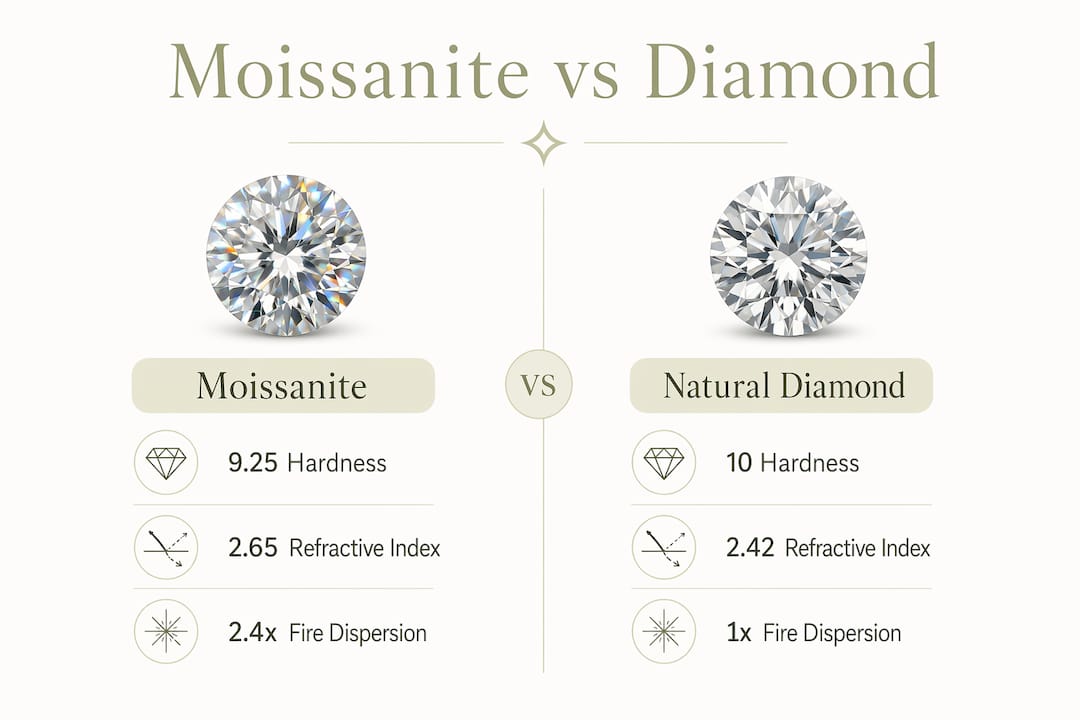
The fire dispersion figure tells the real story. Moissanite disperses light at more than twice the rate of a diamond. That means more color, more sparkle, and more visual presence per dollar spent.
Is moissanite an ethical choice compared to mined diamonds?
Moissanite is 100% lab-grown, which guarantees conflict-free sourcing with zero mining environmental damage. No land displacement, no water contamination, no labor exploitation. That guarantee is absolute, not a certification that depends on a supply chain audit.
Ethical luxury buyers are driving real change in the jewelry market. The demand for traceable, sustainable stones has grown sharply, and moissanite sits at the center of that shift. Choosing moissanite reduces your carbon footprint compared to a mined diamond without requiring you to sacrifice beauty or prestige.
The ethical advantages of moissanite include:
- Conflict-free origin. Every moissanite stone is lab-created, so there is no possibility of funding conflict mining operations.
- No land or ecosystem damage. Diamond mining displaces topsoil, disrupts water tables, and leaves permanent scars on landscapes. Lab creation avoids all of that.
- Lower carbon footprint. Lab-grown gemstone production uses significantly less energy and water than open-pit or underground mining.
- Full traceability. The origin of every moissanite stone is documented and verifiable, unlike many mined diamonds that pass through multiple hands before reaching a retailer.
- Alignment with global ethical standards. Moissanite meets the expectations of buyers who follow ESG principles and want their purchases to reflect their values.
Luxury has always meant something. Choosing a stone with a clean origin adds a layer of meaning that a mined diamond simply cannot offer.
How much does moissanite cost compared to diamonds?
Moissanite costs 80–90% less than natural diamonds. A 1-carat moissanite runs $300–$600. A comparable natural diamond costs $4,000–$8,000. That is not a small difference. It is a category-level gap that changes what is possible with your budget.
The savings scale up dramatically with stone size. A 2-carat moissanite costs $300–$500. A 2-carat natural diamond costs $10,000–$30,000 depending on cut, color, and clarity. Buyers who want a large, visually commanding stone get far more for their money with moissanite.
| Stone size | Moissanite price | Natural diamond price |
|---|---|---|
| 1 carat | $300–$600 | $4,000–$8,000 |
| 2 carats | $300–$500 | $10,000–$30,000 |
| 3 carats | $600–$1,000 (est.) | $20,000–$60,000+ |
The price advantage also frees up budget for better settings. A platinum pavé band, a custom halo design, or a bespoke setting from a skilled jeweler like Vrayasandco becomes financially realistic when the center stone costs a fraction of what a diamond would. That is a real lifestyle upgrade, not a compromise.
Pro Tip: Use the savings from choosing moissanite to invest in a higher-quality metal setting. Platinum or 18-karat gold settings dramatically improve the overall look of any ring and hold stones more securely over decades of wear.
Moissanite does not carry the same resale market as natural diamonds. Buyers who understand this treat moissanite as a lifestyle purchase rather than an investment asset. The value is in the daily experience of wearing a stunning, durable, ethical stone, not in a future resale price.
Why are consumers moving away from diamonds toward moissanite?
Diamond searches have declined 15% while interest in alternative gemstones has surged. Sapphire searches rose 44% and emerald searches rose 31%, signaling a broad shift away from the diamond-first mentality that dominated jewelry buying for decades. Moissanite is a central part of that shift.
The consumer trend toward alternative gemstones reflects a deeper change in values. Millennial and Gen Z buyers prioritize personal expression over tradition. They want rings that reflect who they are, not what a marketing campaign told their grandparents to buy. Moissanite fits that demand precisely because it combines visual impact, ethical origin, and a price point that does not require years of saving.
The shift also reflects a growing rejection of the idea that a stone's value is determined by its rarity or market price. Buyers increasingly ask what a stone looks like, where it came from, and what it means to them personally. Moissanite answers all three questions well.
Key reasons buyers are choosing moissanite over diamonds:
- Personal expression. Moissanite's distinctive fire and sparkle stand out rather than blend in with conventional diamond rings.
- Ethical alignment. Buyers who care about sourcing choose moissanite because its lab-created origin is verifiable and clean.
- Size and visual impact. The price gap allows buyers to choose larger stones without financial strain.
- Style flexibility. Moissanite works in every setting style, from vintage to modern minimalist, without looking out of place.
- Generational values. Younger buyers see no prestige in overpaying for a mined stone when a lab-created alternative performs better optically.
How to choose moissanite jewelry that maximizes value and style
Moissanite comes in a range of grades and color categories. The highest tier, often labeled as colorless or near-colorless, achieves a clarity and whiteness that is indistinguishable from diamonds to the casual eye. Premium grades like Forever One represent the top of the moissanite quality spectrum and deliver eye-clean stones with no visible inclusions.
Choosing the right setting matters as much as choosing the right stone. White gold and platinum settings complement colorless moissanite by reflecting white light back through the stone. Yellow or rose gold settings work beautifully with near-colorless grades and create a warmer, more vintage aesthetic. The setting should protect the stone's girdle and allow maximum light entry from above.
Practical tips for buying moissanite jewelry:
- Choose colorless grades for the most diamond-like appearance. Near-colorless grades are slightly warmer but cost less and still look stunning in yellow gold.
- Buy from jewelers with clear return and certification policies. Reputable jewelers provide documentation of the stone's grade and origin.
- Consider your lifestyle. Moissanite is suitable for daily wear and low-maintenance use, but prong settings need periodic checking to keep stones secure.
- Clean moissanite with warm soapy water and a soft brush. Ultrasonic cleaners are generally safe, but check with your jeweler first.
- Think about long-term style. Classic cuts like round brilliant and oval age well. Trendy cuts may feel dated in a decade.
Vrayasandco offers bespoke moissanite settings built directly in their own factory, which means the quality control is direct and the pricing reflects actual production cost rather than retail markup.
Key takeaways
Moissanite is the definitive smart luxury gemstone for 2026 because it combines superior optical performance, guaranteed ethical sourcing, and cost savings of 80–90% compared to natural diamonds.
| Point | Details |
|---|---|
| Superior fire and brilliance | Moissanite produces 2.4 times more fire than diamonds, making it visually more striking per dollar. |
| Exceptional durability | A Mohs score of 9.25 makes moissanite suitable for daily wear in rings, bracelets, and watches. |
| Ethical and conflict-free | Lab-created origin guarantees zero mining damage and fully traceable, conflict-free sourcing. |
| Dramatic cost savings | Moissanite costs 80–90% less than natural diamonds, freeing budget for better settings or larger stones. |
| Growing consumer preference | Diamond searches have declined 15% as buyers prioritize personal expression and ethical choices. |
What four generations of gemology taught me about moissanite
Most of the resistance I hear about moissanite comes from people who have never held one under proper lighting. They expect it to look cheap. It does not. The fire is actually more intense than a diamond's, which surprises people every time. The honest truth is that moissanite's sparkle is different from a diamond's, not lesser. It is bolder, more colorful, and more alive in motion.
As a GIA Certified gemologist and a fourth-generation jeweler, I have worked with every major gemstone category. The value proposition of moissanite is genuinely hard to argue against. You get a stone that is harder than sapphire, more brilliant than diamond by measurable optical standards, and completely free of the ethical baggage that comes with mining. The only thing you give up is the cultural story that diamonds built around themselves over the last century.
The buyers who choose moissanite are not settling. They are making a deliberate, informed decision to prioritize what the stone actually does over what tradition says it should cost. That is a more sophisticated approach to luxury than writing a large check for a mined stone because a marketing campaign told you to. I see this shift accelerating, and I think it reflects genuine maturity in how people think about jewelry.
The misconception I push back on hardest is the idea that moissanite lacks prestige. Prestige in jewelry comes from craftsmanship, design, and the meaning behind the piece. A beautifully set moissanite in a hand-crafted platinum band from a skilled jeweler carries more genuine prestige than a poorly set diamond in a mass-produced setting. The stone is one part of the story. The rest is the workaround it.
— Vrayas
Bespoke moissanite jewelry at Vrayasandco
Vrayasandco designs and builds moissanite jewelry directly in its own factory, which means every piece reflects direct quality control and honest pricing. The brand's GIA-certified expertise goes into every setting, from iced-out moissanite pieces to custom engagement rings built around your exact specifications.

Clients who want a stone that performs brilliantly, sources ethically, and fits a real budget find exactly that at Vrayasandco. The combination of fourth-generation craftsmanship and lab-created moissanite produces pieces that stand alongside any fine diamond jewelry. Explore bespoke moissanite rings at Vrayasandco and see what the right stone in the right setting actually looks like.
faq
What makes moissanite a luxury gemstone?
Moissanite scores 9.25 on the Mohs hardness scale and produces 2.4 times more fire than a diamond, making it a genuinely high-performance gemstone. Its lab-created origin and premium grades deliver eye-clean, colorless quality that rivals any fine stone.
How does moissanite compare to diamond in everyday wear?
Moissanite is highly durable and suitable for daily wear, outperforming cubic zirconia and rivaling sapphires in scratch resistance. It requires minimal maintenance and holds its brilliance over decades.
Is moissanite a good choice for an engagement ring?
Moissanite engagement rings offer exceptional brilliance, full durability, and conflict-free sourcing at 80–90% less than natural diamond rings. They are a practical and ethical choice for buyers who want a meaningful, lasting ring.
Can people tell the difference between moissanite and diamond?
Premium colorless moissanite grades are indistinguishable from diamonds to the casual observer. The main visible difference is moissanite's greater fire, which produces more colorful flashes in bright light.
Why are younger buyers choosing moissanite over diamonds?
Diamond searches have declined 15% as Millennial and Gen Z buyers prioritize personal expression, ethical sourcing, and value over tradition. Moissanite fits all three priorities better than a mined diamond at any comparable price point.